

14,000 job offers and one overlooked hiring variable
Recruiting leaders spend considerable time examining why people accept employment offers.
Compensation receives attention. Benefits are benchmarked. Employer branding campaigns are developed. Interview processes are redesigned. Recruiters are trained to communicate opportunities more effectively.
But there is another component of the employment offer that frequently sits outside the Talent Acquisition conversation.
The employment agreement itself.
Specifically, the restrictions an organization places on what someone can do after they leave.
In August 2026, researchers Bo Cowgill, Brandon Freiberg, and Evan Starr published a study titled Clause and Effect: Theory and Field Experimental Evidence on Noncompete Clauses in the Quarterly Journal of Economics.
The study appears in the journal's November 2026 issue.
Rather than relying exclusively on employee surveys or historical comparisons, the researchers conducted a field experiment involving approximately 14,000 offers for short-term freelance recruiting assignments across two finance firms.
The experiment varied compensation and different aspects of noncompete provisions. All contracts included nondisclosure agreements.
The results deserve attention from anyone responsible for attracting, hiring, or retaining talent.
2026 FIELD EXPERIMENT | COWGILL, FREIBERG & STARR
~14,000
Job offers included in the experiment
36–52%
Increase in worker mobility
Between the competing employers when noncompetes were removed.
12–17%
Increase in worker earnings
Total earnings from the two participating firms.
No detectable increase in confidential information leakage
Within the experimental setting and the outcomes examined. All contracts retained nondisclosure provisions.Source: Quarterly Journal of Economics, Volume 141, Issue 4, November 2026.
These findings do not establish that every organization should eliminate every restrictive employment agreement.
They do not establish that confidential information is never at risk.
And they do not demonstrate that removing noncompetes will automatically improve offer acceptance or reduce recruiting costs.
What they provide is experimental evidence that employment restrictions can materially influence how workers move between organizations.
For Talent Acquisition, that makes contractual design more than a legal consideration.
It makes it a potential labor-market consideration.
The difference between protecting a business and restricting a career
Organizations have legitimate interests worth protecting.
A business may invest years developing intellectual property. Employees may have access to confidential financial information, sensitive customer relationships, proprietary technology, or commercially valuable strategies.
Protecting those assets is reasonable.
The question is whether every contractual restriction serves the same purpose.
Different employment provisions address different concerns.
Contractual provision
General purpose
Noncompete agreement
Restricts certain competitive employment or business activities after departure.
Nondisclosure agreement
Protects confidential information from unauthorized use or disclosure.
Non-solicitation agreement
Restricts certain solicitation activities involving customers or employees.
Intellectual property assignment
Establishes ownership of specified intellectual property created through employment.
Repayment agreement
May require repayment of specified expenses or benefits under defined circumstances.
These provisions are not interchangeable, and their legal treatment varies by jurisdiction.
An organization concerned about confidential information may have different protection needs from one concerned about customer solicitation.
Yet a standardized employment contract may contain several restrictions regardless of whether the employee's responsibilities create the corresponding business risk.
That is where Talent Acquisition should become interested.
If a restriction is included because it has always been included, rather than because it addresses a demonstrable need, the organization may be introducing unnecessary constraints into its employment proposition.
The relevant question is not simply whether a contractual provision protects the business.
It is whether the protection is appropriate for the actual role.
The retention paradox
Consider an organization that competes aggressively for experienced professionals.
Its recruiters source employees from competitors. Its hiring managers value industry-specific experience. Its leadership wants people who understand the market, customers, and operational challenges.
At the same time, the organization requires its own employees to sign agreements restricting their ability to join competing businesses.
From an individual employer's perspective, the reasoning may appear understandable.
The company wants access to experienced talent while protecting the investments it makes in its own workforce.
But consider what happens when every competing organization adopts the same approach.
The labor market becomes more difficult to navigate.
Experienced workers may face restrictions when changing employers. Recruiters may encounter candidates who are unwilling or unable to pursue certain opportunities. Legal questions may emerge during negotiations or after offers have been accepted.
The company attempting to protect its existing workforce is also recruiting from a workforce that other companies are attempting to protect.
This creates a tension between two business objectives:
Organizations want talent to be mobile when they are hiring and less mobile when they are retaining.
That tension does not establish that all restrictive agreements are inappropriate.
It does suggest that workforce mobility should be part of the conversation when organizations design employment contracts.
The research extends beyond one experiment
The November 2026 study is not the only research examining the relationship between noncompete agreements and worker mobility.
In September 2025, the Journal of Political Economy published research by Matthew Johnson, Kurt Lavetti, and Michael Lipsitz examining the labor-market effects of noncompete enforceability.
The researchers found that stronger enforceability was associated with reduced worker earnings and mobility. They also identified effects extending across state borders.
Their analysis suggests that restrictions can influence employment opportunities beyond the workers who directly sign them.
nber.org+1
Earlier research examined Oregon's 2008 prohibition on noncompete agreements for hourly workers.
Published in Management Science, the study found that the policy change increased average hourly wages by approximately 2%–3% among the affected hourly workforce. It also found improvements in movement between jobs and occupational outcomes.
Three studies, three different research approaches
2026 — Randomized field experiment
Examined contractual changes across two participating firms and short-term freelance recruiting assignments.
Quarterly Journal of Economics
2025 — Labor-market analysis
Examined differences in noncompete enforceability and their relationship with earnings and employment mobility.
Journal of Political Economy
2022 — State policy evaluation
Examined employment and wage outcomes following Oregon's restrictions on noncompetes for hourly workers.
Management Science
These studies examine different populations, periods, and contractual environments.
Their numerical findings should not be combined or treated as interchangeable.
However, they provide complementary evidence that restrictions on employment mobility can affect economic outcomes.
For Talent Acquisition leaders, the implication is worth exploring.
The availability of qualified candidates is not determined exclusively by how many qualified people exist.
It can also be influenced by how freely those people can pursue opportunities.
The federal noncompete ban is not in effect
Any discussion of noncompete agreements in the United States requires an important clarification.
In April 2024, the Federal Trade Commission announced a final rule that would have broadly prohibited noncompete agreements, subject to specified provisions and exceptions.
However, a federal district court blocked enforcement of the rule on August 20, 2024.
The FTC subsequently pursued an appeal before taking steps to dismiss that appeal on September 5, 2025.
As of November 25, 2026, the FTC's official rule page states that the rule is not enforceable.
Federal Trade Commission
This does not mean that all noncompete agreements are lawful.
Nor does it mean that employers have unrestricted authority to impose them.
State laws, applicable federal law, contractual circumstances, and the nature of the restrictions remain relevant.
For organizations recruiting across multiple jurisdictions, this creates an operational challenge.
An employment agreement appropriate for one location may require different treatment elsewhere.
A standardized offer process may encounter increasingly complex contractual requirements.
And recruiters should not be expected to independently determine whether a candidate's existing restrictions are enforceable.
Those questions belong with appropriately qualified legal professionals.
The Talent Acquisition responsibility is different.
It is to ensure that contractual issues do not become unmanaged surprises during the hiring experience.
The offer letter is part of the hiring experience
Imagine a candidate completing a six-week hiring process.
They have met the recruiter, hiring manager, potential colleagues, and executive leadership. They have discussed compensation, responsibilities, professional development, and organizational culture.
They are excited about the opportunity.
Then the employment documents arrive.
For the first time, they discover a provision restricting certain employment activities after their departure.
The candidate now has additional questions.
What would happen if the position were eliminated?
Would they be able to continue working in their industry?
Would the restriction affect their ability to accept another opportunity?
Would they need legal advice before signing?
This is an illustrative scenario, not a documented case from the research.
But it highlights a practical design problem.
The organization has spent weeks helping the candidate understand the opportunity while leaving an important potential condition of employment until the final stage.
The employment agreement is not separate from the candidate's experience simply because it is administered by another department.
From the candidate's perspective, it is part of the same decision.
A recruiter may deliver an excellent experience throughout the interview process, only for an unexpected contractual requirement to introduce uncertainty at the point of acceptance.
That does not mean the recruiter failed.
It may mean the organization designed the hiring process and the employment contracting process independently.
The candidate experiences both.
What happens when candidates do not fully understand the restrictions?
One of the more revealing observations from the 2026 field experiment concerns worker awareness.
The researchers found evidence suggesting that many workers did not recognize the noncompete restrictions until receiving communications after employment. They also found no evidence in their experiment that workers selected restricted positions in exchange for higher compensation.
IZA@LISER Network
This challenges a convenient assumption about employment contracting.
Organizations may assume that because a candidate signed an agreement, the candidate fully understood the practical implications of every provision.
But signing a document and understanding its consequences are different things.
A candidate may be focused on the salary.
They may be excited about the opportunity.
They may be managing a resignation deadline, financial obligations, or competing offers.
They may not understand how a particular clause could affect their future.
An employer cannot reasonably guarantee that every candidate comprehends every legal detail.
It can, however, make important employment conditions easier to identify and provide reasonable opportunities for questions and independent review.
This is not an argument against written agreements.
It is an argument for informed employment decisions.
An organization that values transparency should care about whether the people accepting its offers understand what they are accepting.
The difference between retention and immobility
Employee retention is commonly treated as a positive organizational outcome.
And in many circumstances, it is.
Experienced employees preserve institutional knowledge. Stable teams can maintain relationships, develop expertise, and support long-term business objectives.
But retention statistics describe whether employees remain with an organization.
They do not necessarily explain why.
Consider two hypothetical businesses.
ORGANIZATION A
90%
Annual employee retention
Employees remain because they receive competitive compensation, meaningful development opportunities, supportive leadership, and flexibility.
ORGANIZATION B
90%
Annual employee retention
Some employees remain because they perceive substantial legal, contractual, or financial barriers to pursuing other employment.
Hypothetical comparison. The retention figures are illustrative and are not drawn from research or client data.
Both organizations report the same retention outcome.
But the underlying employee experiences may be very different.
The example demonstrates why retention alone cannot establish workforce satisfaction, engagement, or commitment.
An employee who wants to remain and an employee who feels unable to leave may appear identical on a workforce dashboard.
For Talent Acquisition, that distinction matters.
Recruiters frequently communicate an organization's culture, development opportunities, and employee value proposition to prospective hires.
The credibility of those messages depends on what employees actually experience.
Organizations should aspire to retain people because the employment relationship continues to provide mutual value, not merely because departure is difficult.
The operational burden nobody assigns to a department
Contractual restrictions can also create administrative work.
Consider the following hypothetical hiring sequence.
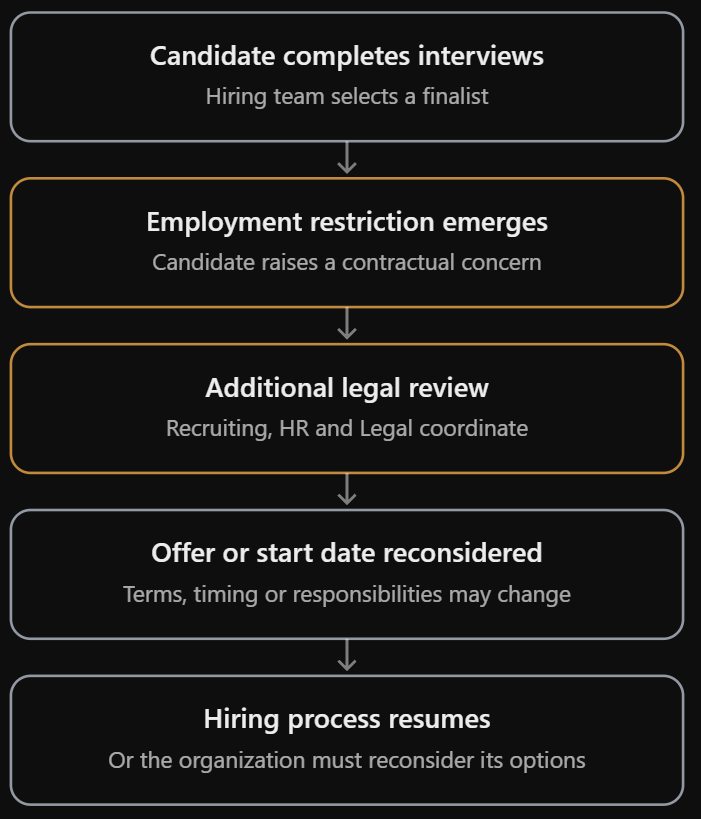
None of these activities is necessarily inappropriate.
Legal review may be essential. Employment conditions may need to be clarified. Start dates may legitimately change.
The operational question is whether the issue could have been identified earlier.
Late contractual surprises may require additional meetings, repeated communications, document revisions, and coordination between departments.
If the candidate ultimately withdraws, the hiring team may need to reconsider other applicants or reopen the search.
The organization may record the final outcome as a declined offer.
But that classification alone may not explain what happened.
Was compensation inadequate?
Did the candidate receive a better opportunity?
Were the employment terms unacceptable?
Did a restriction imposed by a previous employer prevent the transition?
Did the organization simply run out of time?
These are different circumstances with different implications.
A recruiting dashboard that treats them as identical can obscure opportunities for improvement.
What could this mean in hours rather than dollars?
There is insufficient evidence in the research reviewed for this article to establish an industry-wide cost of contractual friction during recruiting.
However, leaders can examine the administrative implications using transparent hypothetical scenarios.
Consider an organization that encounters 24 hiring cases involving late contractual clarification over a year.
Assume each case requires additional time from recruiting, legal, and the hiring manager.
The following calculator illustrates the possible workload under assumptions selected by the reader.
Contractual clarification workload
Contractual clarification workload
Estimate the annual cross-functional time associated with hiring cases that require additional contractual clarification.
Under these assumptions, 24 cases requiring 4 combined additional hours each would create 96 hours of annual cross-functional workload.
These hours represent modeled workload, not proven waste or recoverable savings. Necessary legal review should not be eliminated simply to accelerate hiring.
Under the default assumptions, the organization spends 96 combined hours addressing these cases.
That is equivalent to 12 eight-hour working days distributed across the participating departments.
It does not mean that all 96 hours could be recovered.
Some of the work may be unavoidable.
Some may protect the organization from significant risks.
The opportunity is to distinguish necessary work from preventable rework.
An earlier conversation may not eliminate the need for legal review, but it could reduce the number of decisions that must be revisited after the hiring process is substantially complete.
That is a hypothesis an organization can evaluate using its own evidence.
Why this matters to executives, not just recruiters
Contractual friction crosses organizational boundaries.
Talent Acquisition is responsible for attracting and progressing candidates.
Legal is responsible for advising on legal risks and appropriate protections.
Human Resources manages aspects of the employment relationship.
Business leaders are responsible for workforce capability and continuity.
Finance evaluates the resources required to operate the business.
Each department has legitimate priorities.
The problem emerges when those priorities are addressed independently without considering their combined effect on hiring.
A recruiter may be measured on hiring speed.
A legal team may prioritize risk reduction.
A hiring manager may prioritize securing the most experienced candidate.
An executive may prioritize employee retention.
All four objectives can be reasonable.
But an organization needs to understand where they reinforce one another and where they create competing demands.
An employment agreement should not be considered successful solely because it provides extensive contractual protection.
Likewise, a hiring process should not be considered successful solely because it produces a signed offer quickly.
Both activities support a broader employment relationship.
The quality of that relationship deserves consideration alongside the individual departmental objectives.
The questions leaders should bring to Legal and HR
Talent Acquisition should not independently rewrite restrictive employment agreements.
Nor should recruiters provide candidates with assurances about enforceability that they are not qualified to make.
Instead, recruiting leadership can contribute a perspective that may otherwise be missing from contractual discussions: how employment terms affect the organization's ability to attract people and help them make informed decisions.
A productive leadership discussion could examine the following questions.
Leadership question
Why it matters
What specific business interest does each restriction protect?
Helps distinguish necessary protections from historical contract language.
Does the restriction reflect the responsibilities of the role?
Different positions may create different business risks.
When do candidates learn about material employment conditions?
Earlier visibility can support informed decisions.
Who handles questions about a candidate's existing agreements?
Prevents recruiters from being placed in inappropriate legal advisory roles.
Are contractual concerns contributing to offer withdrawals or delays?
Establishes whether a measurable recruiting issue exists.
Are employment agreements reviewed when laws or business practices change?
Helps maintain relevance across jurisdictions and operating environments.
Could a narrower protection address the same business interest?
Creates an opportunity for qualified legal review of proportionality.
These are general leadership discussion questions, not a legal compliance checklist or proprietary PathPair diagnostic procedure.
The objective is not to remove protections indiscriminately.
It is to understand whether the organization has selected protections that reflect its actual needs.
What the research does not tell us
The strength of the 2026 field experiment should not become an excuse to overstate its findings.
The participating workers were freelance recruiters completing short-term assignments for two finance firms.
That setting differs from many permanent employment relationships.
A senior executive with access to sensitive acquisition plans presents a different risk profile from a freelance recruiter.
A pharmaceutical researcher working on proprietary discoveries presents different considerations from a retail employee.
A cybersecurity specialist with privileged access to infrastructure may have different contractual requirements from an administrative employee.
The study cannot resolve every one of those situations.
Its findings also do not establish that eliminating noncompetes universally increases wages by 12%–17%.
The reported earnings effect concerns the two firms and experimental conditions examined.
Similarly, the absence of detectable additional confidential information leakage in that experiment does not establish that disclosure risks are nonexistent in other industries.
Responsible leaders should resist converting a compelling research result into a universal business rule.
The evidence supports taking employment restrictions seriously as a factor influencing worker mobility.
The appropriate organizational response still depends on context.
A better definition of competitive employment
Organizations frequently describe themselves as competing for talent.
But competition involves more than offering a higher salary or developing a recognizable employer brand.
It involves giving people meaningful reasons to choose one employment relationship over another.
That includes the quality of leadership, opportunities for development, compensation, working conditions, organizational purpose, and the terms governing the relationship.
A competitive employment proposition should be evaluated in its entirety.
An attractive salary may coexist with restrictive conditions.
An excellent interview experience may coexist with unclear contractual expectations.
A compelling employer brand may coexist with employment practices that candidates find difficult to reconcile with the organization's stated values.
These tensions deserve examination.
The goal is not to make every employment agreement identical.
It is to ensure that the organization's employment proposition is intentional, understandable, and consistent with the relationship it wants to establish.
An exercise for your next leadership meeting
Instead of reviewing another competitor's career website or benchmarking another compensation range, bring a representative employment agreement into the conversation.
Read it from the perspective of someone considering joining your organization.
Not from the perspective of the person who drafted it.
Not from the perspective of the executive approving it.
From the perspective of someone deciding whether to trust the organization with the next several years of their professional life.
What obligations are clear?
What questions might arise?
Which conditions would materially influence that person's decision?
Would they have learned about those conditions before investing substantial time in the hiring process?
And if they wanted clarification, would they know whom to contact?
The answers may reveal opportunities to improve the experience without changing compensation, purchasing technology, or adding another recruiting platform.
Sometimes the most valuable hiring improvements are not new capabilities.
They are better connections between capabilities the organization already possesses.
Would your employees choose you again?
Every organization has a responsibility to protect its legitimate business interests.
Every worker also has an interest in maintaining the ability to build a career, support a family, and pursue professional opportunities.
Those interests do not have to be treated as inherently incompatible.
Thoughtful employment agreements can protect sensitive information while remaining understandable. Hiring processes can provide clarity without making inappropriate legal assurances. Organizations can pursue retention through meaningful employment experiences while maintaining appropriate contractual protections.
The challenge is designing those elements together.
The 2026 research offers a reason to reconsider assumptions about the necessity and consequences of employment restrictions.
But it also raises a larger question about the nature of employment itself.
A company spends considerable time persuading a candidate to choose it.
The interview process communicates why the opportunity matters. The recruiter explains why the organization is worth joining. The hiring manager describes what the person could become.
Those promises should continue to matter after the agreement is signed.
Because perhaps the most meaningful measure of an organization's ability to compete for talent is not whether it can prevent people from leaving.
It is whether people would still choose to stay if they were free to leave.
Sources & Further Reading
1. Clause and Effect: Theory and Field Experimental Evidence on Noncompete Clauses
Bo Cowgill, Brandon Freiberg & Evan Starr
Quarterly Journal of Economics • Volume 141, Issue 4 • November 2026 • Pages 3161–3209
Primary peer-reviewed research underpinning this edition. Examines the effects of experimentally varied noncompete provisions on worker behavior, earnings, and information leakage.
Read the original researchPublished online August 7, 2026. DOI: 10.1093/qje/qjag040
2. Clause and Effect — IZA Discussion Paper No. 18820
Cowgill, Freiberg & Starr • July 2026
Earlier working-paper version of the same field experiment. Useful for further examination of the research design and theoretical context. Not counted as independent corroborating research.
3. The Labor Market Effects of Legal Restrictions on Worker Mobility
Matthew S. Johnson, Kurt J. Lavetti & Michael Lipsitz
Journal of Political Economy • Volume 133, Number 9 • 2025
Examines how differences in noncompete enforceability affect earnings, worker mobility, and broader labor-market outcomes.
Read the published studyRead the NBER working-paper version
4. Low-Wage Workers and the Enforceability of Noncompete Agreements
Michael Lipsitz & Evan Starr
Management Science • Volume 68, Issue 1 • January 2022 • Pages 143–170
Evaluates Oregon's 2008 policy change and its effects on hourly workers' wages, occupational outcomes, and mobility.
5. Noncompete Rule — Federal Trade Commission
Official federal regulatory resource • Status reviewed November 25, 2026
Provides the current enforceability status of the FTC's noncompete rule and information concerning the related litigation.
